Appearance
Objective-C 语法看不懂
OC 是个啥啊,竟然看不懂。
扩展名
hello world
cpp
#import <Foundation/Foundation.h>

int main(int argc, char *argv[]) {

    @autoreleasepool {
        NSLog(@"Hello World!");
    }

   return 0;
}
变量
函数
接口
cpp
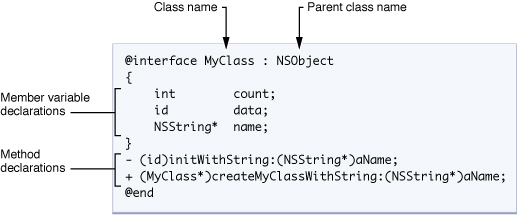
@interface MyObject : NSObject {
    int memberVar1; // 实体变量
    id  memberVar2;
}

+(return_type) class_method; // 类方法

-(return_type) instance_method1; // 实例方法
-(return_type) instance_method2: (int) p1;
-(return_type) instance_method3: (int) p1 andPar: (int) p2;
@end
方法前面的 +/- 号代表函数的类型:
- 加号(+)代表类方法(class method),不需要实例就可以调用,与C++ 的静态函数(static member function)相似。
- 减号(-)即是一般的实例方法(instance method)。
cpp
@interface Person : NSObject {
    @public
        NSString *name;
    @private
        int age;
}

@property(copy) NSString *name;
@property(readonly) int age;

-(id)initWithAge:(int)age;
@end
类 - 实现接口
cpp
@implementation MyObject {
  int memberVar3; //私有實體變數
}

+(return_type) class_method {
    .... //method implementation
}
-(return_type) instance_method1 {
     ....
}
-(return_type) instance_method2: (int) p1 {
    ....
}
-(return_type) instance_method3: (int) p1 andPar: (int) p2 {
    ....
}
@end
cpp
@implementation Person
@synthesize name;
@dynamic age;

-(id)initWithAge:(int)initAge
{
    age = initAge; // 注意:直接赋给成员变量,而非属性
    return self;
}

-(int)age
{
    return 29; // 注意:并非返回真正的年龄
}
@end
对象
Objective-C创建对象需通过alloc以及init两个消息。alloc的作用是分配内存,init则是初始化对象。 i
cpp
// 创建对象
MyObject * my = [[MyObject alloc] init];
方法调用
cpp
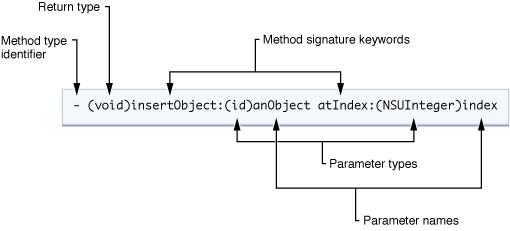
obj.method(argument);

[obj method: argument];
控制语句
yes no
cpp
比如C#里你可以这么写:

this.hello(true);

在Objective-C里,就要写成:

[self hello:YES];
更新: 2021-05-13 20:41:35
原文: https://www.yuque.com/u3641/dxlfpu/ufudpp